

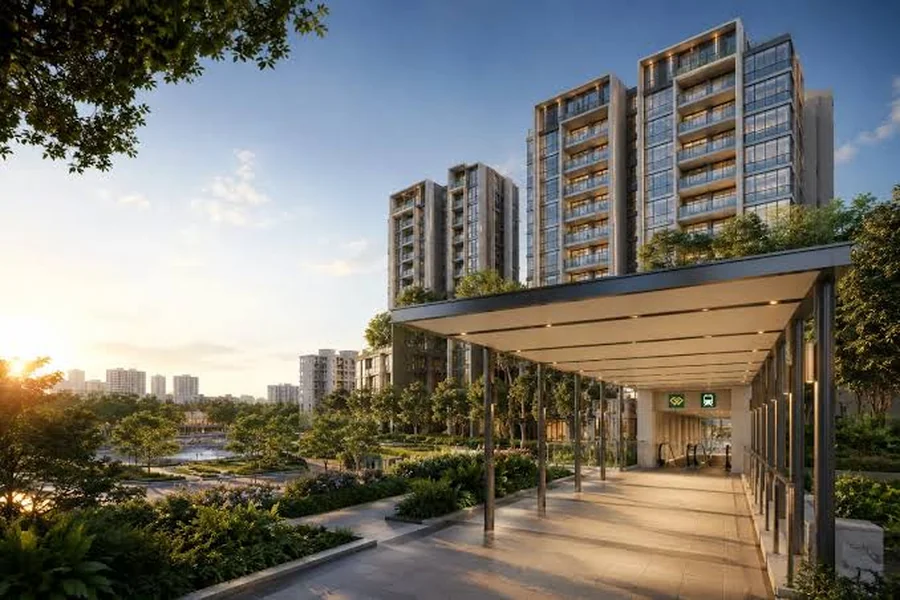
Bedok Rise Residences Reimagines Scarce Station Land for Community Living
In land-conscious Singapore, a new condominium beside an MRT station is more than another addition to the skyline. It is an opportunity to bring homes closer to the transport infrastructure that shapes everyday life. At Bedok Rise, next to Tanah Merah MRT Station, Bedok Rise Residences by Allgreen Properties gives that opportunity a residential focus: a 380-home community on scarce station-adjacent land.
The significance lies in the relationship between the site and the people who will call it home. Land beside an established station cannot simply be reproduced elsewhere. Bringing residences into this setting makes a limited resource relevant to hundreds of households, connecting the privacy of home with the shared advantages of a well-connected address. It is a proposition grounded less in spectacle than in the enduring usefulness of place.
Bedok Rise Residences Gives Scarce Station Land a Residential Purpose
Station-adjacent land holds a distinctive position in Singapore’s urban landscape. Its appeal comes not only from location, but also from the infrastructure already serving it. An MRT station represents an established connection to the wider city, giving nearby housing a practical foundation that extends beyond the boundaries of an individual development.
Bedok Rise Residences translates that locational advantage into 380 homes. Rather than viewing the site solely through the language of scarcity, the more meaningful perspective is what that scarcity can support: a residential community whose daily routines begin close to public transport. The land’s value becomes tangible through ordinary journeys, repeated over years of occupation.
From a Station Address to an Everyday Advantage
Proximity to Tanah Merah MRT Station is central to the project’s identity because it can influence how residents organise their days. For households that use rail regularly, being next to the station can reduce reliance on a separate feeder journey and make public transport a more natural starting point. The benefit is practical rather than abstract.
That relationship matters across different routines. Working residents may appreciate a straightforward connection to the rail network, while households coordinating several schedules gain another transport option close to home. Individual destinations and journey times will vary, but the underlying advantage remains consistent: the station is part of the immediate residential setting, rather than a destination that first requires another trip.
Bedok Rise Residences Brings Community Scale to a Connected Site
The 380-home scale gives the development a clear community dimension. This is not simply a collection of private addresses sharing proximity to a station. It is an opportunity for a neighbourhood within the development to take shape, bringing together residents whose circumstances may differ but whose everyday experiences overlap.
Community does not emerge from a unit count alone. It develops through familiarity, consideration and repeated encounters over time. Recognising a neighbour on the way home or exchanging a greeting before the morning commute can gradually make an address feel more personal. At Bedok Rise Residences, the station-side setting provides a common reference point around which those individual lives can unfold.
Making Limited Land Work Beyond the Individual Home
A well-located residential site serves more than the needs contained within each apartment. It also shapes the relationship between households and their surroundings. When homes sit beside public transport, residents have the option to make rail travel part of their routine without treating access to the network as a separate logistical exercise.
This is an important expression of land use in Singapore: placing homes where established infrastructure can support them. It does not require every resident to travel in the same way. Rather, it broadens the choices available from a single address. For a 380-home community, that shared access gives scarce station land a purpose extending well beyond its physical footprint.
Allgreen Properties Connects the Address with a Residential Vision
With Allgreen Properties behind the project, Bedok Rise Residences brings an established Singapore property name to this station-side opportunity. The developer’s involvement adds a recognisable point of reference for buyers considering how a scarce parcel of land will become a place to live.
The essential promise, however, remains grounded in the relationship between location and residential purpose. A station-side address attracts attention; its relevance as a home depends on how closely it aligns with household priorities. Here, the proposition is clear: new condominium living at Bedok Rise, beside Tanah Merah MRT Station, within a community of 380 homes. Buyers can assess that proposition against their own routines and longer-term needs.
A Finite Site with an Enduring Role in Daily Life
The strongest reading of Bedok Rise Residences is not scarcity for scarcity’s sake. Limited land becomes meaningful when its location offers something residents can use repeatedly. In this case, the defining advantage is the close relationship between home and station, bringing a major element of Singapore’s transport network into the immediate context of everyday living.
Turning that site into a 380-home community gives the headline its substance. The transformation is from land beside infrastructure to homes connected by it, and from an individual location advantage to a benefit shared across many households. For buyers who place lasting emphasis on rail access and a connected residential setting, Bedok Rise Residences presents a focused proposition: scarce station land given a clear, human purpose.
